Why Do Expensive Black Jackets Turn Gray?
Why Do Expensive Black Jackets Turn Gray?
An educational series from Lan's Lapels Dry Cleaning, North Andover, MA
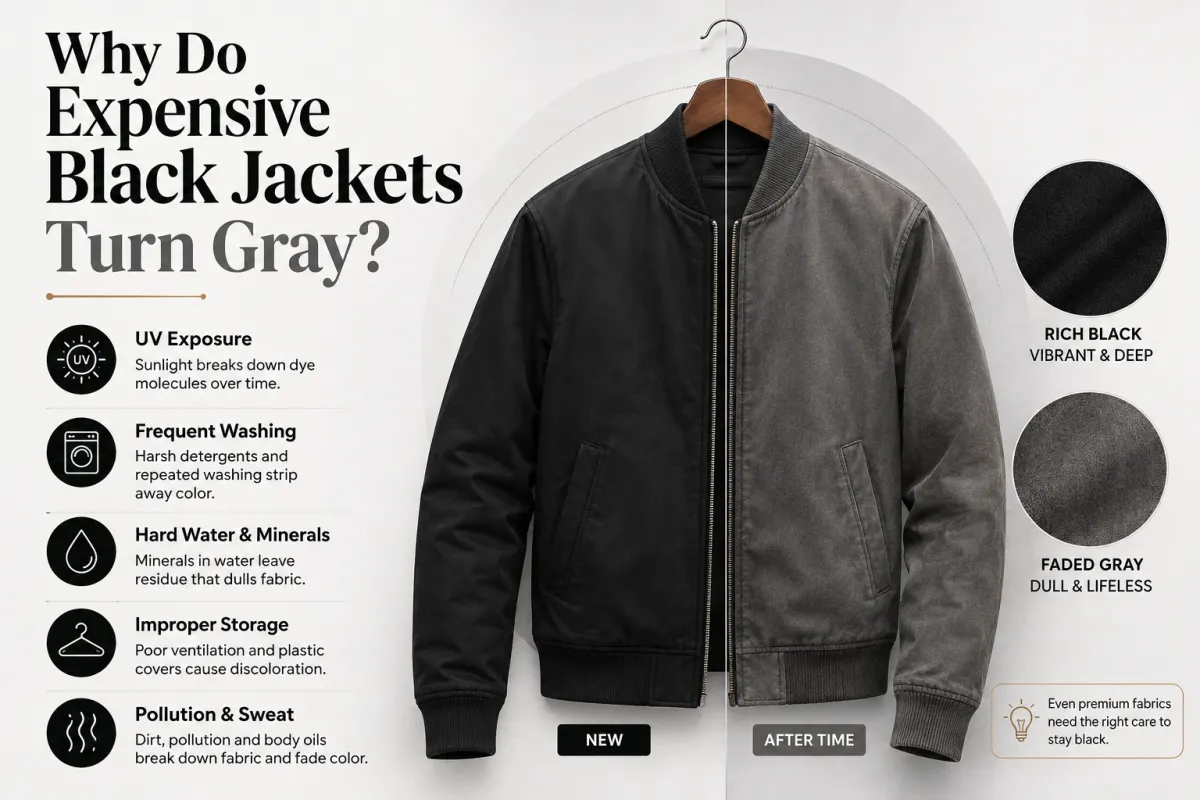
Have you ever noticed that an expensive black winter jacket — a Canada Goose, Moncler, The North Face — starts looking gray around the pockets, cuffs, hood, or zipper, even though you've taken good care of it?
Many people assume the last cleaner caused the fading. In reality, textile science usually tells a different story.
Where Does the Wear Come From?
A premium jacket is exposed to thousands of small friction points during everyday use: seat belts, backpack and purse straps, car doors, armrests, hands going in and out of pockets, and sleeve cuffs rubbing against desks and steering wheels.
These repeated contact points gradually wear the outer fibers of the fabric. As surface fibers thin, two things happen at once: the fibers become slightly polished (which reads as “shine”), and the dye at the very surface is rubbed away (which reads as graying, whitening, or “frosting”). Textile professionals call this abrasion wear — and it explains why jackets almost never fade evenly. They fade where they’re touched.
Why Does It Often Become More Noticeable After Cleaning?
Professional cleaning removes the soils, body oils, and residue that can temporarily mask existing wear. Cleaning does not create abrasion — but a clean fabric surface shows honestly what was already there.
This is especially common with black nylon shells, polyester performance fabrics, water-resistant outerwear, and down jackets, because these fabrics rely on surface dye systems and protective DWR (Durable Water Repellent) finishes that are engineered to be durable — not permanent.
Heat Damage vs. Normal Wear: How Experts Tell Them Apart
Heat damage and abrasion leave very different physical fingerprints.
Heat damage may produce:
Melted fibers
Distorted fabric
Glossy heat marks
Press impressions — typically uniform or covering broad areas
Abrasion typically appears as:
Localized whitening
Color loss on raised edges and seams
A smoother surface texture
Wear concentrated on high-contact areas like cuffs, pocket flaps, and hood edges
An experienced textile analyst can distinguish between these conditions under examination. For the record: down jackets should never be ironed or pressed, and a professional down-cleaning process doesn't do either. At Lan's Lapels, down garments go through a dedicated wet-cleaning program with controlled drying to restore the insulation's loft, followed only by gentle steaming from the lining side to relax wrinkles. An iron never touches the shell.
Why Independent Analysis Matters
When there's a disagreement about the cause of a garment's condition, the most reliable approach is independent textile analysis — not assumptions. Independent laboratories evaluate garments based on fiber characteristics, wear patterns, and scientific examination. Their goal is not to defend the customer, the manufacturer, or the cleaner, but to determine the most likely cause based on physical evidence.
We put that principle into practice. We submitted a premium down parka showing exactly this type of fading to the International Textile Analysis Laboratory (ITAL) — the independent damaged-garment testing division of the Drycleaning & Laundry Institute — for a formal photo examination and textile analysis. Their written conclusion, issued June 29, 2026, was clear:
“The fading and abrasion observed are consistent with progressive wear and normal care. This degree of color loss is to be expected in fabrics of this type and is not associated with any improper cleaning procedures.”
— International Textile Analysis Laboratory, Expert Report, June 29, 2026. Signed by Brian Johnson, CPD, CPW, CED — Director of Education & Analysis, Drycleaning & Laundry Institute.
The examination found no evidence of chemical damage, heat damage, or improper cleaning — and noted that many performance fabrics use dye methods that lack complete colorfastness at the surface, so surface dye can lighten from nothing more than normal friction and wear.
Our Commitment
At Lan's Lapels, we believe every customer deserves an honest answer. When necessary, we seek independent textile analysis rather than relying on opinions alone — because protecting our customers also means protecting the truth.
Have a jacket you're wondering about? Bring it by. We'll look it over and tell you honestly what we see.
Sources
International Textile Analysis Laboratory (ITAL), Drycleaning & Laundry Institute — Expert Report, June 29, 2026 (on file at our store)
AATCC TM8, Colorfastness to Crocking — the standard test method for color transfer caused by surface rubbing (AATCC, the American Association of Textile Chemists and Colorists)
ASTM International standard test methods for textile abrasion resistance